
The Basics of Fall Protection – Academy
[ad_1]
Those who work at an elevation should be very aware of their surroundings, proceed with caution and use (personal) fall protection to keep them safe.
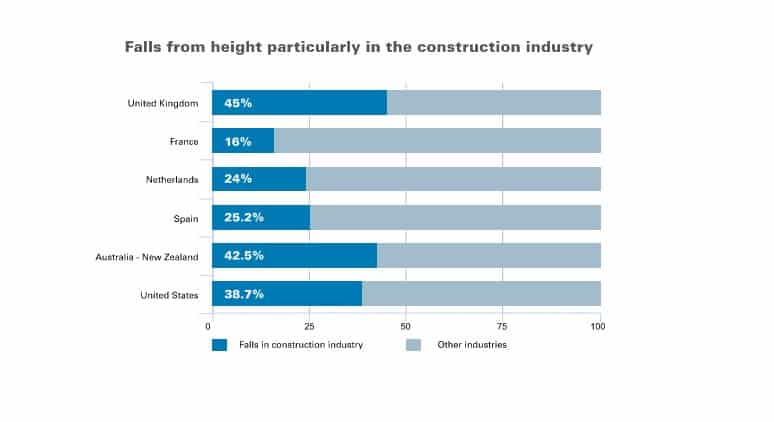
Falls from height are a major cause of workplace injuries and deaths all over the world. The UK and Australia each noted 25 deaths in 2016 caused by a fall from height at work and in the USA a staggering 849 people were killed at work due to slips, trips and falls.
These statistics show that working at height is no joke and that there is much to gain from using fall protection. Because, and that is the most unfortunate part, these deaths where preventable in most cases.That’s why we have put together the basics of fall protection in this whitepaper. By raising awareness and implementing safety measures, such as a fall protection plan and by selecting the proper fall protection systems for the job you will keep yourself and others safe.
Rules and Regulations
Most governments have implemented strict rules when it comes to working at height. As falls from height still claim many victims. A common thread in these regulations is that working at height should be avoided if not necessary. If the work cannot be done at ground level, measures have to be taken to ensure safety of the workers while working at height. This could mean the installation of temporary guardrails, or the use of Personal Protective Equipment (PPE) for fall protection.
Responsibility
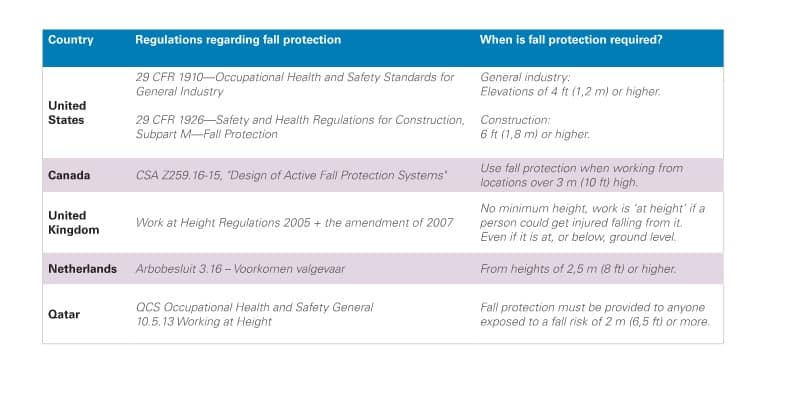
Employers (and/or building owners) are responsible for providing a safe workplace with fall protection and the associated training. Employees, however, also have a responsibility.
They have to make use of the provided fall protection equipment and assess their own safety. If equipment isn’t in a good condition or a situation is unsafe, they should report to their supervisor. Before starting to work at height we urge you to check your local regulations to see what rules should be applied:
Risk Analysis
Before any work at height is started all fall hazards have to be mapped and analyzed. Experts in risk assessment can provide the information that is necessary to choose the right fall protection for the situation.
Fall Protection Plan
Some countries demand that employers or building owners generate a fall protection plan for those who work at height on their location. A fall protection plan is, as the name indicates, a safety plan to protect workers from falls while working in elevated areas.
In this plan all the fall hazards identified by the risk assessment and the fall protection solution to combat the risks are detailed. This can mean describing procedures, but it also means clarifying why certain fall protection methods are selected and how users will receive the associated and necessary training.
Rescue Plan
An extra addition to the fall protection plan is the rescue plan. Every location where work at height is performed should have a plan in place to rescue workers in case of a fall.
Often people want to rely on emergency services, but some locations are too far away, meaning the response time is longer than desirable. Or the emergency services aren’t equipped to rescue someone from an elevated position. This will all need to be thought through before an emergency occurs.
This is why a good rescue plan should specify who is responsible for the rescue, the procedures on how to rescue and where to find the rescue equipment.
Training
All employees who are faced with fall hazards should be properly trained in identifying hazards, following safety procedures, the proper use and inspection of fall protection systems and PPE, and the rescue procedures. Training employees creates awareness and helps them understand that safety procedures are there for their own personal safety. Good training helps prevent serious incidents.
What are the options?
Completely removing fall hazards is the preferred method to keep everyone safe, this would mean bringing the work to a safe level or installing collective fall protection measures. However, sometimes there is no other option than to work at height. After all buildings need to be constructed, solar panels have to be maintained and so on and so forth.
There are several systems and solutions available to combat fall hazards. They can be divided into two categories permanent fall protection solutions and Personal Protective Equipment (PPE) for fall protection purposes. One does not exclude the other, for some permanent solutions workers are required to wear corresponding PPE. After all wearing a full body safety harness alone won’t protect you from a fall, you need to attach yourself to an anchor in order to stay safe.
- Fall arrest systems allow workers to reach all areas including the zones where fall risks are present. When a fall occurs the system will arrest the fall, preventing the person from hitting a lower level. The victim of a fall can then either perform self-rescue, or will need to be rescued by colleagues or a third party.
- Fall restraint solutions allow workers to perform their duties at height, but prevent them from reaching a situation where a fall could occur. This is the preferred solution when collective fall protection is not an option.
Permanent Fall Protection
Permanent fall protection is the term used to describe safety solutions which are permanently present on a building. Most permanent systems have to be used in combination with fall protection PPE, so that users can connect to a system. The only exception to this are guardrails.
Guardrails
This fall protection system can transform the entire roof into a safe zone. In this case, users do not have to wear PPE in this situation and an unlimited amount of users can work safely. Guardrails can either be installed permanently on a structure or freestanding, where they are held in place with counterweights.
Lifeline and Rail Systems
A lifeline system is a permanent cable track consisting of a wire-rope that runs through multiple anchor points which are fixed on a roof, wall or overhead structure. A rail system is a rail mounted on anchor points, this system is more rigid than a lifeline system.
Both the lifeline and rail system have to be used in combination with fall protection PPE and a special runner, this allows users to move along the trajectory.
Single Anchor Points
Anchor points are permanent anchors installed on the surface of a structure, to which a user can connect with fall protection PPE. The user can only move around the anchor point they are attached to, if they need to move further they will need to attach to another anchor point. For extra freedom of movement a temporary lifeline can be placed between two anchor points, this way a user can walk along this line.
Maintenance
In many countries fall protection systems have to be re-evaluated and certified every year. If your countries does not have this regulation, we do advise to have your fall protection systems inspected annually to warrant the safety of the system.
The ABC of Fall Protection
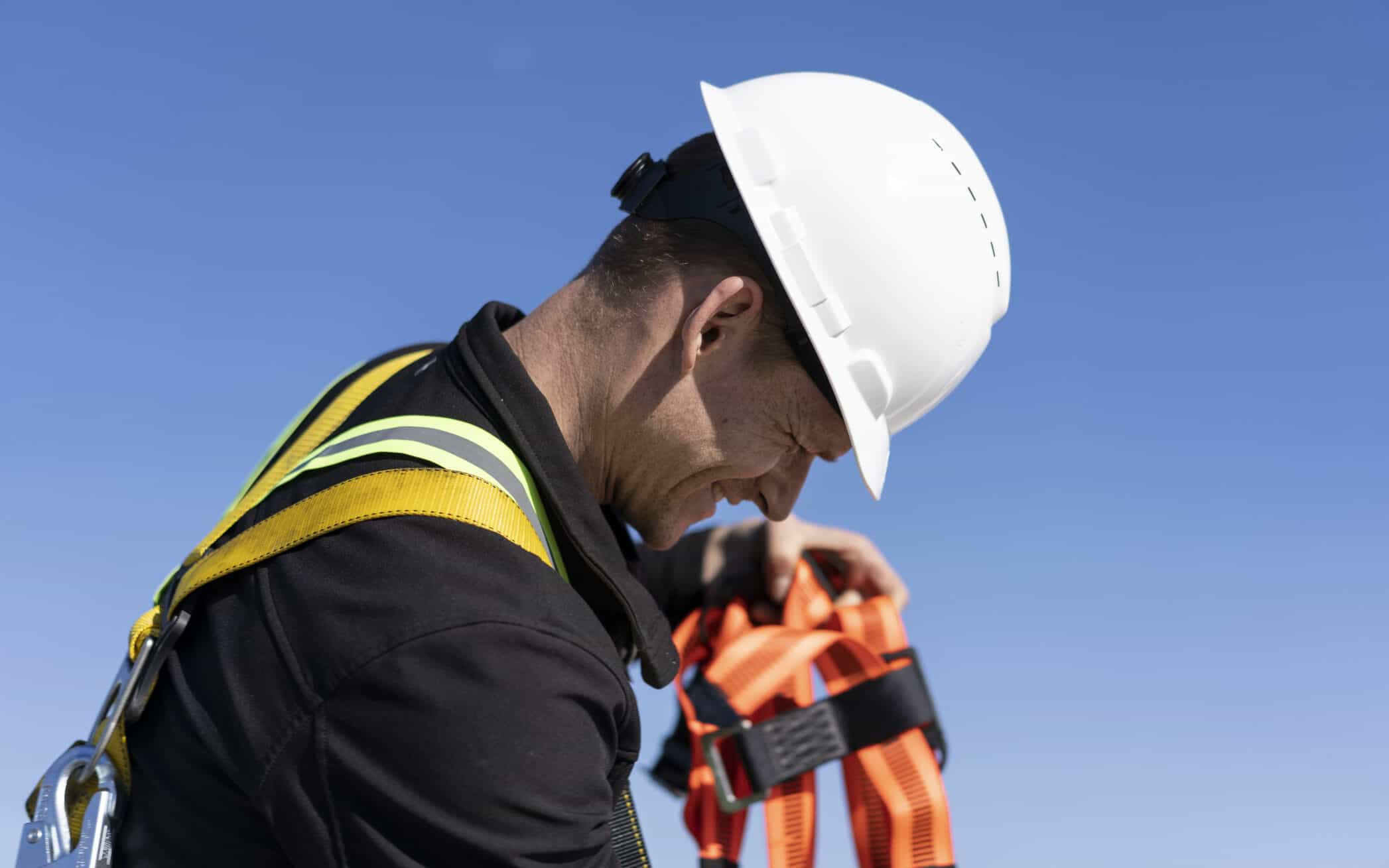
The ABC of fall protection PPE comprises of the three fundamental elements that form a fall protection system. Each component must be compatible with each other and used correctly in order to provide the safety.
A – Anchorage
A secure point to which a wor-keris attached; can be portable or temporary fixed. Temporary anchor points are used when no permanent fall protection system is available on the job site and a safe working envi-ronmentmust be created.
B – Body Support
A full body harness to distribute the forces over the worker’s body in case a fall is arrested.
C – Connecting Device
These connect the A and the B; they connect the worker to the anchor point.
About The Harness
Choosing the right safety harness can make a big difference. Not only when it comes to comfort, but also in preventing serious injuries.
- What harness is best suited for the job depends on:
- The type of work that is performed;
- The duration of the work;
- The weight of the user;
- The level of comfort that’s needed; and
- The number of attachment points that are needed.
ABOUT CONNECTING DEVICES
The connecting device, such as a lanyard or Self-Retracting Lanyard (SRL), (C) connects a worker’s full body harness (B) to the anchor point (A). There are several different types of lanyards to choose from, the most important distinction is that there are lanyards for fall arrest and for fall restraint.
Fall arrest lanyards are used in fall protection systems that are meant to arrest the user in case of a fall. These lanyards are always equipped with a Personal Energy Absorber (PEA) to minimize the impact forces of a fall arrest on the human body. Fall restraint lanyards are designed to limit the reach of a user so that they cannot reach the rood edge, dangerous skylights or other situations that can lead to a fall hazard.
Pre-work and Annual Inspection
All fall protection PPE must be checked for damages and de-formation before each use to ensure maximum safety. If there is any doubt about the safety of the PPE take it out of service immediately.
Fall protection PPE needs to be checked and re-certified annually by a competent person who is trained and certified in checking, maintaining and approving fall protection PPE products.
Retire Equipment
Working with fall arrest situations can mean that a person can fall over an unprotected edge. Wearing the right fall protection PPE will arrest the fall before that person can hit a lower level. However, in a fall a person can get hurt, and hanging in suspension is no pleasure either.
The best way to rescue a person from hanging in a harness is preparation. Having a rescue plan that is made for all kinds of fall situations, will aid the rescue efforts.
If all personnel know the contents of the rescue plan then they know their tasks in case of an emergency and this will prevent chaos. The rescue team will then be able to work swiftly without being hindered. Which is very important as a person that’s hanging in a harness could be left with serious damage as their blood circulation is disrupted.
After a person is rescued from suspension ensure that they get evaluated by a healthcare professional.
Investigate how the accident happened and if any measures can be taken to prevent future incidents. Assess if the rescue plan was adequate, or if improvements can be made. Any equipment involved in a fall arrest has to be removed from service. Both the fall protection system, such as a lifeline, and the PPE used by the person who fell, need to be inspected and re-certified by a competent person before it can be used again. If it is damaged or broken it needs to be destroyed.
Seek Advice
Selecting the right fall protection for a project can be difficult with all the different and (sometimes local) rules and regulations, the difference between various systems and the building or job specific requirements. Therefore it is always good to consult a fall protection expert to advise which fall protection system works best for your situation.
[ad_2]
Source link